
The spread of SARS-CoV-2 in Mozambique and in the world has already taken an alarming shape, affecting thousands of people and, consequently, affecting the functioning of several areas. Like other countries, Mozambique interrupted all academic activities as a measure to prevent the spread of the new coronavirus.
A statement to the nation by the President of the Republic announced the closure of all public and private schools, from pre-school to higher education, with effect from 23 March, leaving thousands of children at home and without power have classes.
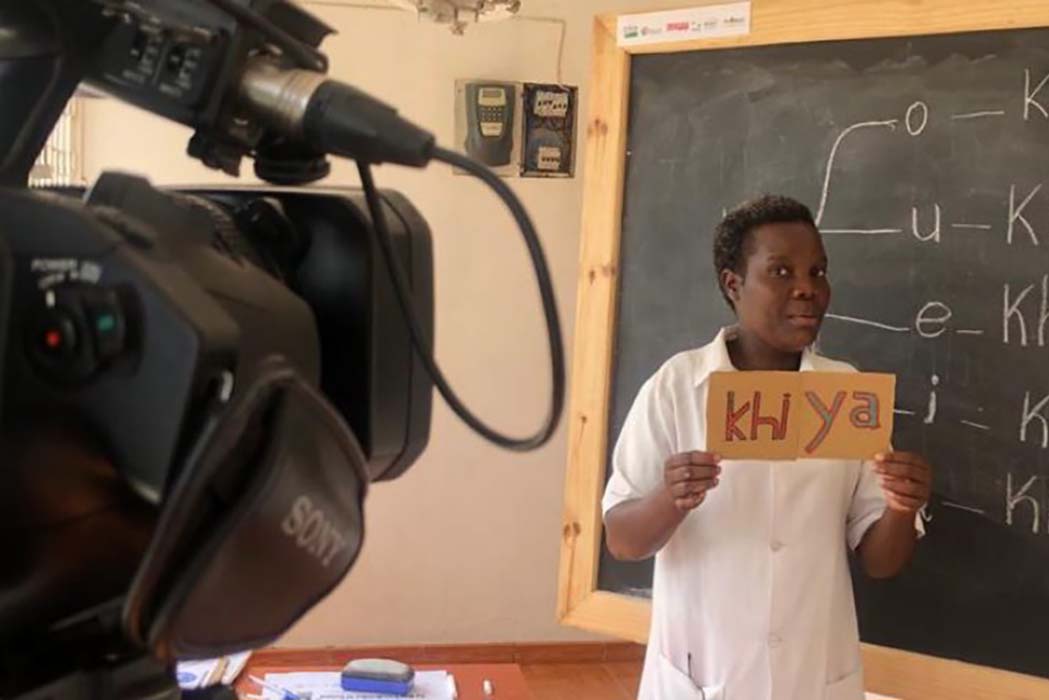
As a way to mitigate the effects of COVID-19, ADPP through its School Feeding project, “Food for Knowledge”, a project from Planet Aid, and in coordination with the Ministry of Education and Human Development (MINED), started a program for transmitting bilingual education classes through community radio stations and television.
This project is sponsored by the United States Department of Agriculture (USDA) and the adopted activities will cover Xichangana disciplines for students in grades 1 to 3 and for students in grade 3 in bilingual education.
The radio classes are broadcast by the community radio stations in the districts where the project “Comida para o Saber” is being implemented, namely the districts of Manhiça, Magude, Matutíne and Momba, and by the provincial transmitter of Maputo of Rádio Moçambique. The classes through television are transmitted by Television of Mozambique (Maputo provincial delegation), whose schedules for both platforms follow three hours a day.
The radio and television classes are designed for the students’ practice, as a way to improve phonetics, vocabulary, fluency and comprehension. These components are directed through guided practices, including reading and writing stories and other semi-structured activities led by the teacher who guides the radio or television broadcast, and use the learning materials that students have at home. In addition, the lessons provide strategies to encourage family members (literate or not) to support student learning and literacy practice at home.
This joint initiative aims to engage students and teachers to promote the continuity of their teaching activities even though schools remain closed for reasons that aim to mitigate the spread of the new coronavirus within the student community, in particular, and the Mozambican population in general.