
ADPP Mozambique, in partnership with the Aga Khan Foundation, has distributed agricultural inputs and tools to 550 smallholder farmers affected by floods in Gaza Province, under the Emergency WASH Response and Agricultural Recovery Project.

The distribution took place in the community of Nwachicoluane, in Chókwè District, where each farmer received a kit containing 10 kilograms of maize, two kilograms of cowpea, a hoe and a machete. The support aims to help farmers resume agricultural production and restore the livelihoods of affected families.
As part of this intervention, which is supporting a total of 4,200 smallholder farmers, work is also underway to rehabilitate 30 damaged boreholes, disinfect critical water points and conduct hygiene promotion sessions, with the aim of reaching approximately 9,000 people.
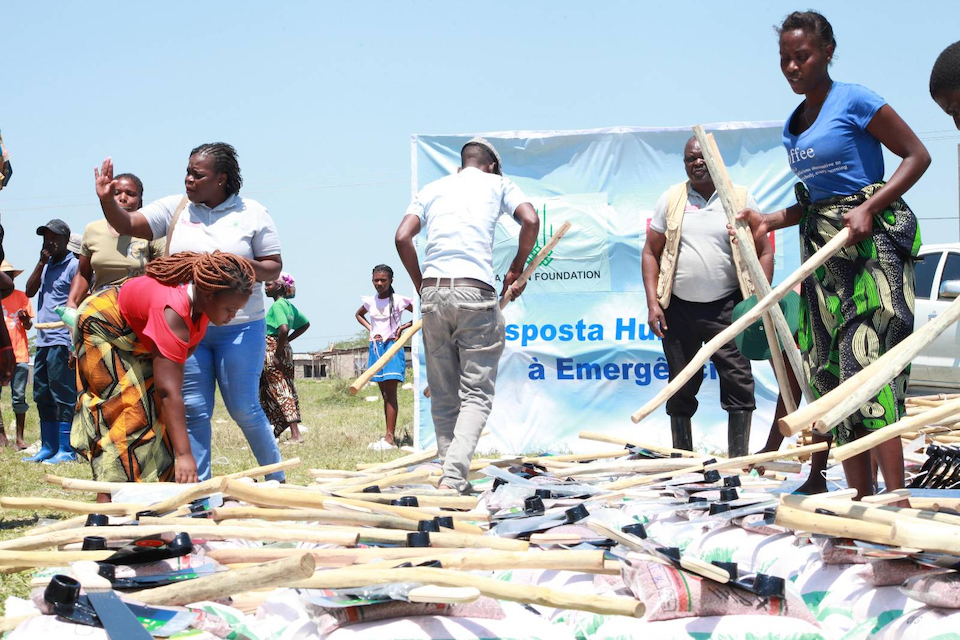
Nostício Chaúque, an agricultural extension officer from the District Services for Economic Activities assigned to Nwachicoluane village, highlighted the importance of this support in restoring agricultural activities in the area.“The floods caused farmers to lose their crops and the food they had stored. This support, in the form of agricultural inputs and tools, gives them hope of starting production again and restoring their livelihoods. We believe the basic conditions for a successful agricultural season are now in place,” he said.
Albino Lebombo, an ADPP production instructor, emphasised the role of technical assistance in ensuring the proper use of the distributed inputs.“We are confident that, with the knowledge gained through training and the support received, farmers will be able to resume production and improve their productivity. We provide guidance on the application of appropriate agricultural techniques so that they can restore their fields, strengthen food security and improve their families’ living conditions,” he explained.

Jutite Mateus Chambal, a project beneficiary, mother of five and grandmother of two, expressed her satisfaction with the support, which will enable her to cultivate her field again.“I am very happy because I now have the means to start cultivating my field again, which was destroyed by the floodwaters. We lost everything we had produced and stored, and we were left without the means to provide food for our family. With these seeds and tools, I have hope again that I can grow food for my family and, in the future, sell part of the harvest to improve our lives,” she said.

The 10-month project aims to mitigate the effects of the floods, which destroyed crops, agricultural inputs and other productive assets, undermining families’ ability to resume farming and ensure their food security. The intervention also seeks to improve access to safe water and sanitation, reducing the risk of diseases such as cholera and diarrhoea associated with contaminated water sources.
